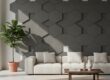


How to choose acoustic materials for a living space
Acoustic materials for a living space — this is the most important aspect of creating a home theater. The right choice of materials can significantly affect sound quality and the overall impression of watching movies or listening to music. At 360° Space Acoustic, we understand that every room is unique and requires an individual approach to selecting acoustic materials.
What factors should be considered when choosing acoustic materials?
When choosing acoustic materials for a living space, several factors must be considered, including the size and shape of the room, the type of acoustic system, and personal preferences. It is also important to consider the materials from which the walls, floor, and ceiling are made, as they can significantly affect the room's acoustics. According to Bruno Putzeys (Kii Audio), directivity truly defines the ratio of direct/reverberant field in the mid/lower-mid range [Kii Audio].
What acoustic materials are best suited for a residential space?
There are many acoustic materials that can be used in a living space, including acoustic panels, diffusers, and absorbers. Acoustic panels can be used to absorb sound waves and reduce reverberation, while diffusers can be used to scatter sound waves and create a more uniform sound field. According to Floyd Toole (Toole), room errors are an order of magnitude larger than electronics errors [Toole, JAES].
How can you improve the acoustics of a living space?
Improving the acoustics of a living space can be achieved through various methods, including the use of acoustic materials, rearranging furniture, and using acoustic systems. It is also important to consider the materials from which the walls, floor, and ceiling are made, and to take measures to reduce reverberation and improve sound quality. At 360° Space Acoustic, we use 3D room scanning to create an individual acoustic system project.
Frequently asked questions
Question 1: How to choose acoustic materials for a living space?
Answer: The choice of acoustic materials depends on many factors, including room size and shape, type of acoustic system, and personal preferences.
Question 2: What acoustic materials are best suited for a residential space?
Answer: There are many acoustic materials that can be used in a living space, including acoustic panels, diffusers, and absorbers.
Question 3: How can the acoustics of a living space be improved?
Answer: Improving the acoustics of a living space can be achieved through various methods, including the use of acoustic materials, changing furniture arrangement, and using acoustic systems.
If you want to create an ideal acoustic environment for your home theater, contact us at 360° Space Acoustic. We offer comprehensive solutions for selecting and installing acoustic materials, as well as providing 3D room scanning services and creating individual acoustic system projects. In our projects, we use our own active 3-way Payos Audio Main Control monitors for precise acoustic control.
Need acoustics advice?
Leave your contact — we'll respond within 30 minutes and calculate the cost